Lifestyle
6 Japanese Storage Habits For A Clutter-Free Home
Written by Fatima Batool
August 23, 2026
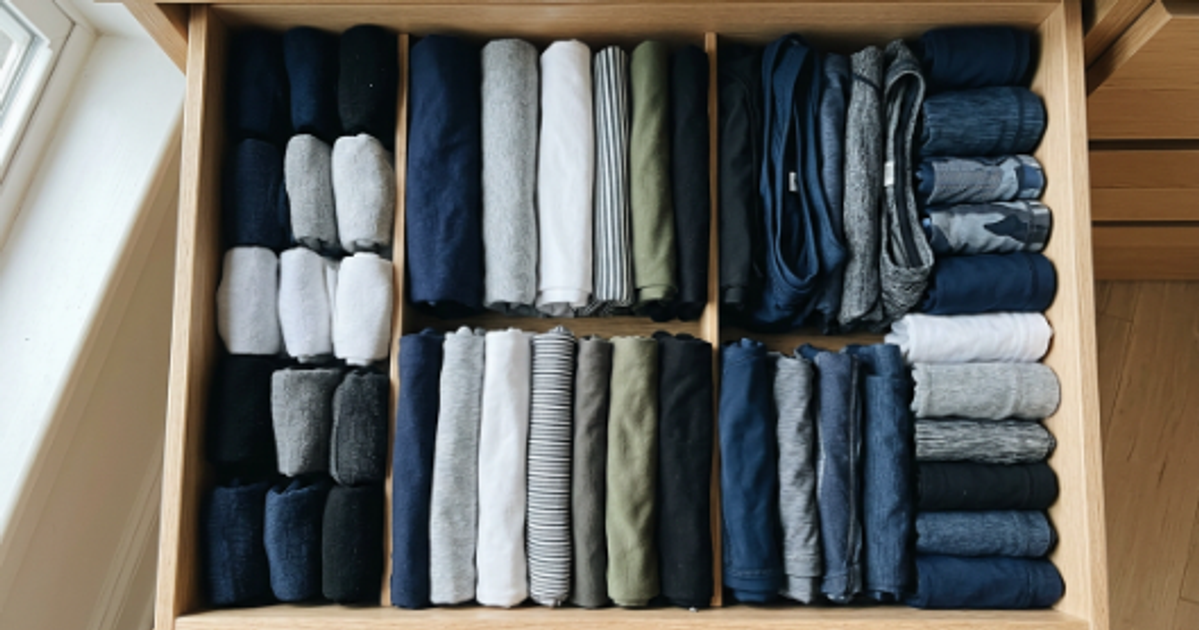
The majority of clutter isn't a discipline issue. It's a storage shape issue. In Japan, there are a few habits that help to prevent this, and six of them describe nearly all of the clutter in people's daily lives. Each one has an easy, affordable solution!
Fold Clothes To Stand Them Up, Not Stack Them Flat
If the clothes are stacked flat, then only the top garment is visible or used. The shirt on the bottom of a six-item stack can sit untouched for years just because you have to lift up all the items above it to reach the bottom shirt. The Japanese one is to fold clothes into little rectangles and then stack them on their side. When the drawer is open, all items are visible from above, and a standing fold will actually occupy less vertical space than a loose flat stack, which allows more to fit in a drawer. This can be done in about four minutes per drawer and doesn't involve any new items being bought.
Give Flat Kitchen Items Their Own Vertical Slots
The same thing happens to the baking sheets, cutting boards, cooling racks, and pot lids when they are stored flat on top of each other, like the clothes drawer. The bottom cabinet is one that is skipped over entirely, as it requires lifting up all the items above it to get to. The Japanese keep these items upright in individual compartments, and an office file holder, a type used for magazines or folders is an effective tool for reproducing this at home. Two file holders that cost less than a ten-dollar cabinet that is a problem solved.
Clear The Kitchen Counter By Moving Tools To The Wall
If a counter is cluttered, then it isn't always clutter. It is a collection of useful objects that were never intended to be collected elsewhere. Each surface or object on a counter, in a knife block, on a coffee maker, in a spice rack, etc., occupies a footprint of "dead space" that cannot be used for actual cooking or prepping. Instead, Japanese kitchens have all the tools hanging from the counter with a magnet or on rails. Frequently-used items go on a wall; a magnetic knife strip becomes available; a hanging rail for utensils is installed; or a paper towel holder is attached to a wall, thus reclaiming that surface area.
Cleaning becomes easier when storage is handled first, as explained in The Daily Habits That Keep Japanese Homes Clean Without Deep Cleaning.
Store the freezer upright and labeled
When you put things to the side in a freezer, the things placed on top are likely to cover things that were placed at the bottom, causing you to buy duplicate items. In the Japanese way, everything in the freezer is kept upright in a container, like files in a filing cabinet, with a label to the front, so that all items are visible immediately after the freezer door is opened. People who have more than one of something, such as a tape measure or scissors, do so for the same reason: it's quicker to have another one than to find the one that isn't in sight!
Add Dividers To Any Catch-All Drawer
Even the most well-organized household ends up having a junk drawer after a while. This is because an undivided space will have no specific location, and objects will simply fall into it. Japanese homes compartmentalize all drawers, and categories such as chargers, batteries, and small tools have their own spaces. Fixes, less than a dollar cost, and only a few minutes per drawer.
Create a dedicated drop zone near the front door
No spot to put something down near the front door, so when mail, keys, bags, or jackets come in, they'll keep coming until they hit a counter, table, or back of a couch is a common thing that happens in many households. The Japanese remedy this by having a genkan a small entryway space where shoes and outdoor belongings are left before accessing the rest of the house. Creating a similar small area in front of the front door with one coat hook, one key and mail tray, and one bag basket will stop these items from coming to any other surface inside the house. This typically creates the quickest seen effect of any individual modification.
The Pattern Behind All Six
They all have the same core concept: Understand the concept of storage in such a way that everything is immediately visible at one glance and it is easy to give each object a fixed place instead of depending on memory to keep a space tidy. None of these involve new furniture or a complete weekend project of reorganization. They're minor shifts in the way space is used, and most require just a couple minutes to implement.