General
What Ancient Kids Actually Played With Before Modern Toys Existed
September 4, 2026
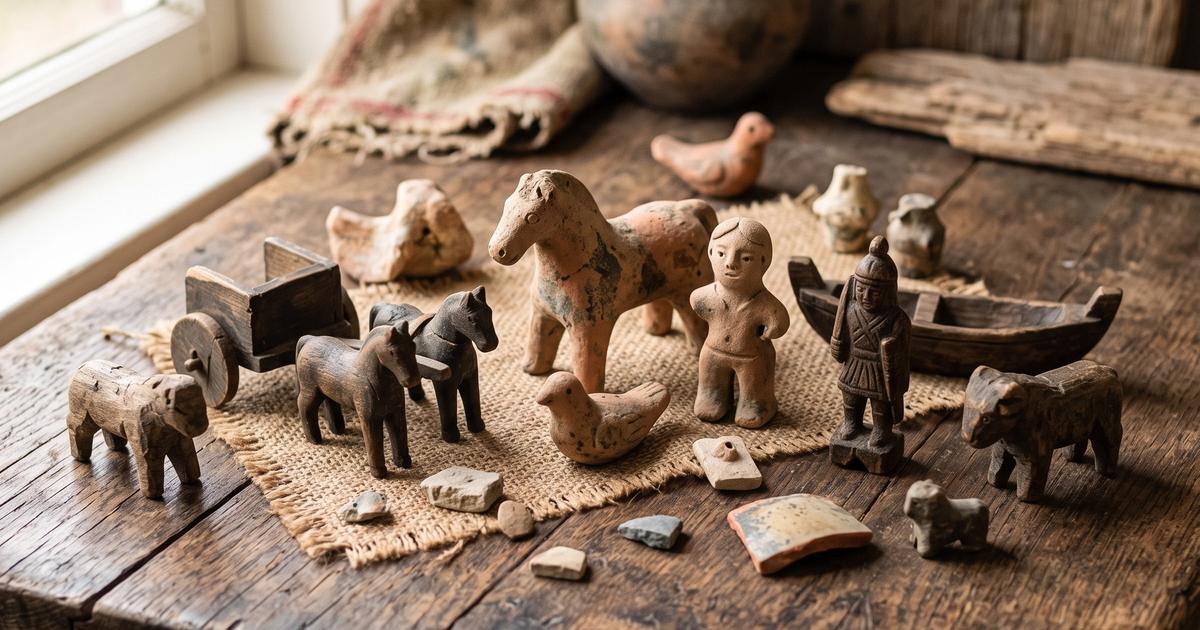
Evidence of children playing with toys dates back thousands of years, and the desire to make up imaginary worlds and games is even older than many think. Sticks and stones had to be the most common ancient playthings but don't survive from the past. What remains instead provides a realistic description of the way children played in the past.
Wheeled Toys and Whistles Appear Thousands of Years Ago
In Anatolia some 3,000 years ago, kids drove miniature toy cars through the mud: the earliest evidence of wheeled toys in the world! Some 1000 years later, in the Indus Valley civilisation, children used dove-shaped terracotta whistles that made a chirping noise. These objects demonstrate that mechanical locomotion and sound-made play were a part of childhood long before written history was rich enough to describe it directly.
Dolls Were Common Across Multiple Ancient Civilizations
Although identification of dolls in the archaeological record is not always easy, they are found throughout the ancient world. Archaeologists see the female figurines and debate whether the figurines were a child's toy or religious fertility idols that are spread across Africa, Europe, and Asia. Dolls with more discernable roles, however, have been well attested in ancient Greece and Rome, and the dolls were built to wear the clothing and hairstyles fashionable among the adults of their day. A doll of ivory, to date around 100 CE, is one that has been preserved, which had jointed arms and legs, and a collection of miniature clothes and accessories. In the Arctic, Inuit children in later times and in a completely different location enjoyed wooden dolls dressed in furs.
Ball Games Were Nearly Universal
The simplest ball of them all could be the most popular ancient toy. Ancient Egyptians, Chinese, Greeks, and Mesoamericans used leather, linen, papyrus, and palm fibre balls to play with. The regulations governing most children's ball games have been lost, but it is possible that children copied adult sporting practices. Episkyros was a ball-throwing game of the Ancient Greeks that involved throwing a ball with the aim of forcing the opposing team out of a set area. A game of hip throwing a rubber ball through a hoop was played in Mesoamerica, and in rituals of this type, children might have been barred from participating in the game.
Gender Shaped Who Got To Play What
In the ancient world, rougher, physical forms of play were usually segregated by gender. In Rome and Egypt, it was typical for girls to be barred from more physically challenging ball games that boys were playing. One notable exception was Sparta: girls there underwent the same strenuous physical training around 400 CE, for the reasons outlined above, and not because it was thought that they and their boys were equal.
Ancient Philosophers Saw Educational Value in Toys
The Greek philosopher Plato specifically described toys such as miniature building blocks, small-scale farming implements, and the like, which helped children to acquire skills they would require as adults. This implies that some ancient societies regarded play as not "just" a way to entertain but as a precursor to practical skill learning, which is very similar to the way that developmental play is perceived by contemporary teachers.
Growing Up Often Meant Formally Giving Up Toys
There have been many ancient cultures that treated the leaving of childhood as something that they had to celebrate ceremoniously with toys. A proverb of the Romans said that a child gave up nuts when he/she was given adult responsibilities, as nuts were used in various children's games. In addition, young Roman girls gave their dolls as gifts for the gods in order to prepare for marriage, thus signalling the end of childhood play and the beginning of adulthood.
Some Games Never Stopped Being Played Into Adulthood
Not every toy was geared towards children. Knucklebones were made from the ankle bones of sheep and were played throughout the ancient Mediterranean as a game of chance, like the game of dice, and in games resembling jacks, where the different bones had different values. Board games, too, were probably introduced during childhood and carried over into adulthood in various civilisations: the Royal Game of Ur in Mesopotamia, Go in China, Senet in Egypt, and Ludus latrunculorum (The Game of Soldiers) in Rome.
The Pattern That Connects Ancient And Modern Play
Even though the materials, the culture, and the technology available to children were vastly different in ancient times, children played in about the same way they do now in the categories of inventing stories with dolls and playing ball games and pushing small vehicles across the floor. The nature of the object has evolved significantly over thousands of years, but the drive to imagine, compete, and develop skills using play seems to be a universal drive in virtually all recorded human civilisations.